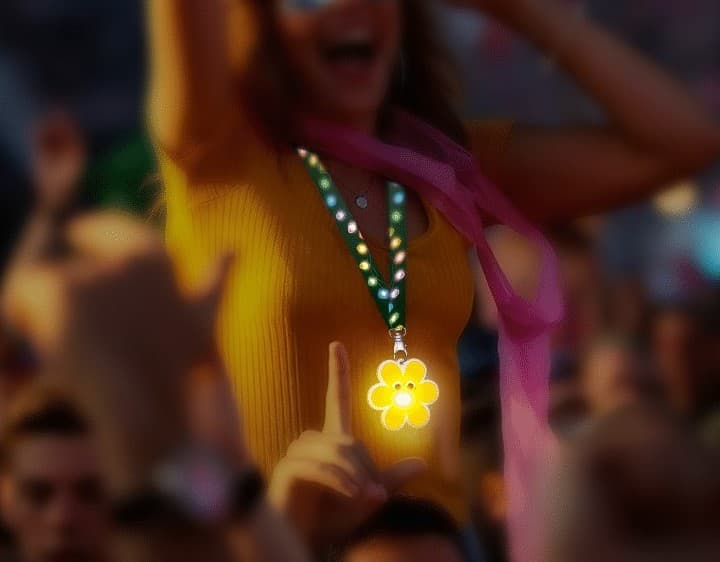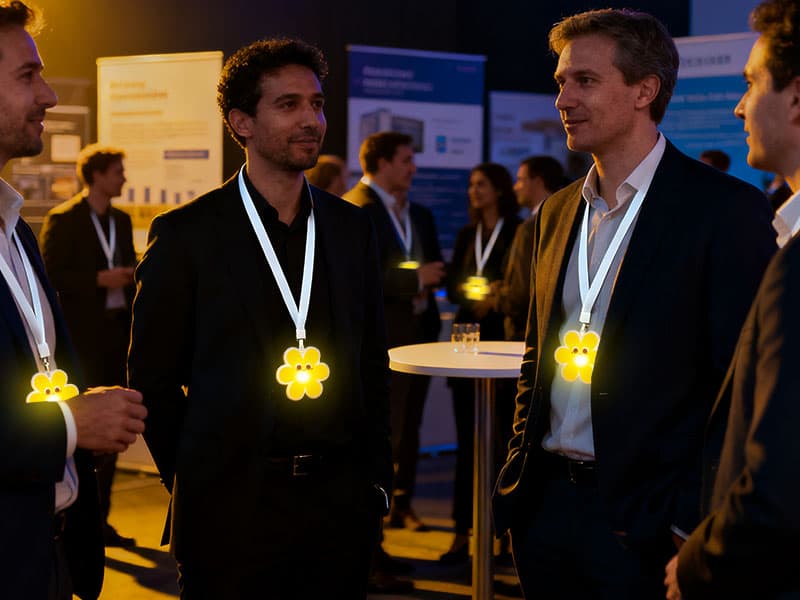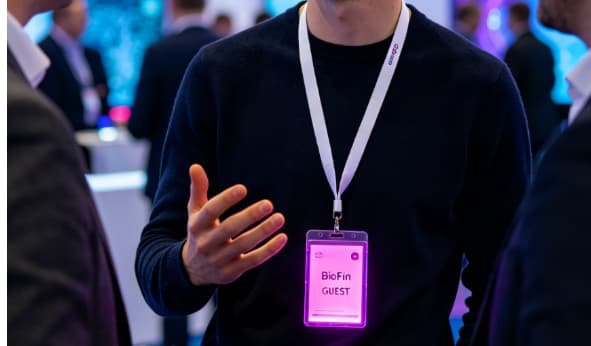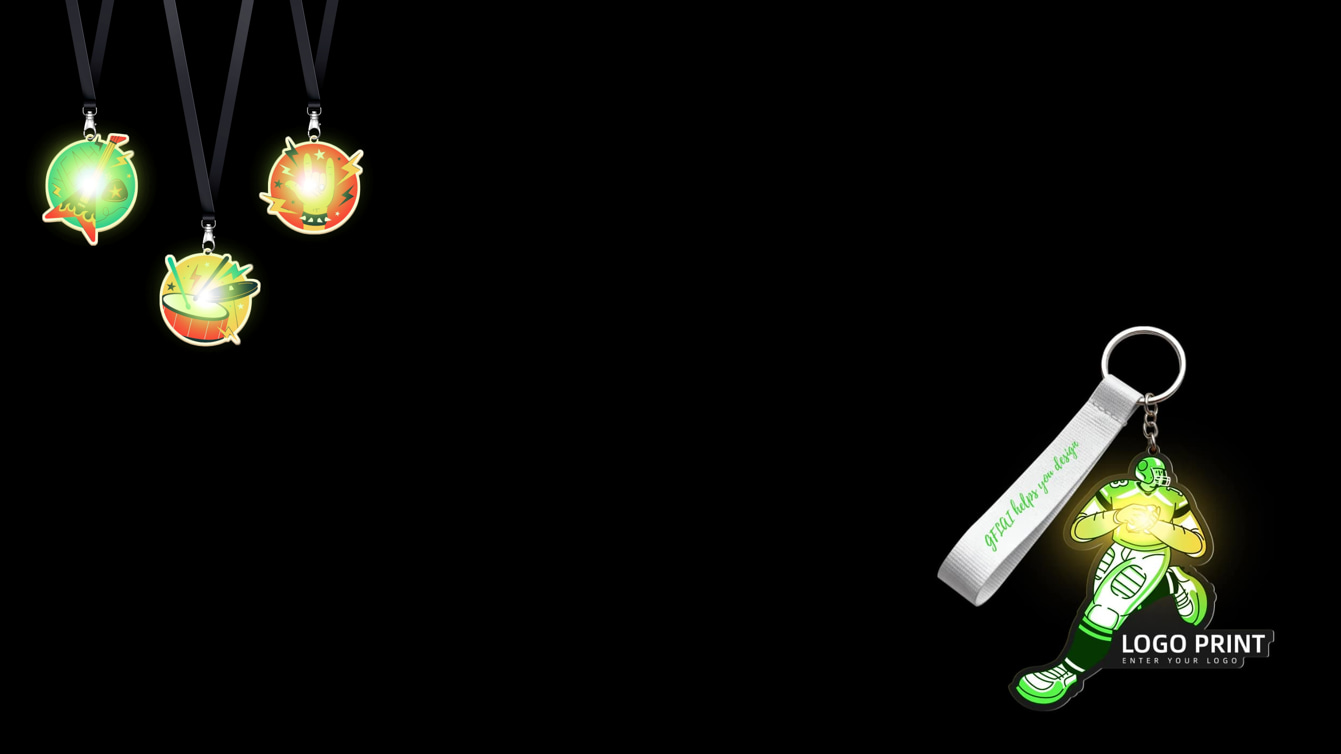
An LED flashing lanyard is a neck strap with a badge that contains light-emitting diodes programmed to turn on and off in repeated patterns. The flashing is generated by a microcontroller inside the badge — not by a mechanical switch or a blinking bulb. Because the pattern is stored in firmware, the flash is consistent, precise, and identical across every unit in a batch.
Three structural layers make up the product: the badge (housing the LEDs, battery, and controller), the strap (carrying your printed branding), and the control interface (push button built-in, with optional RF/DMX/APP transmitters). Each layer is produced in-house and assembled into a single integrated wearable.
The flashing is controlled by a small microcontroller chip inside the badge. The chip turns the LEDs on and off according to a stored timing pattern — exactly like the light controller in LED wristbands and event glow products. Each pattern is a simple on-off sequence: how long the light stays on, how long it stays off, and which color shows.
Every lanyard comes with four built-in patterns stored in the chip. Tapping the push button steps through them in order. This is standard, proven electronics — the same mechanism used across the LED wearable industry — and it is what makes the flash timing identical across every unit in your order.
Every LED flashing lanyard ships with four built-in patterns, switched by tapping the push button:
Gentle on-off pulse. Ambient visibility, VIP areas, elegant events.
Rapid blink. High-visibility staff ID, safety marking, crowd location.
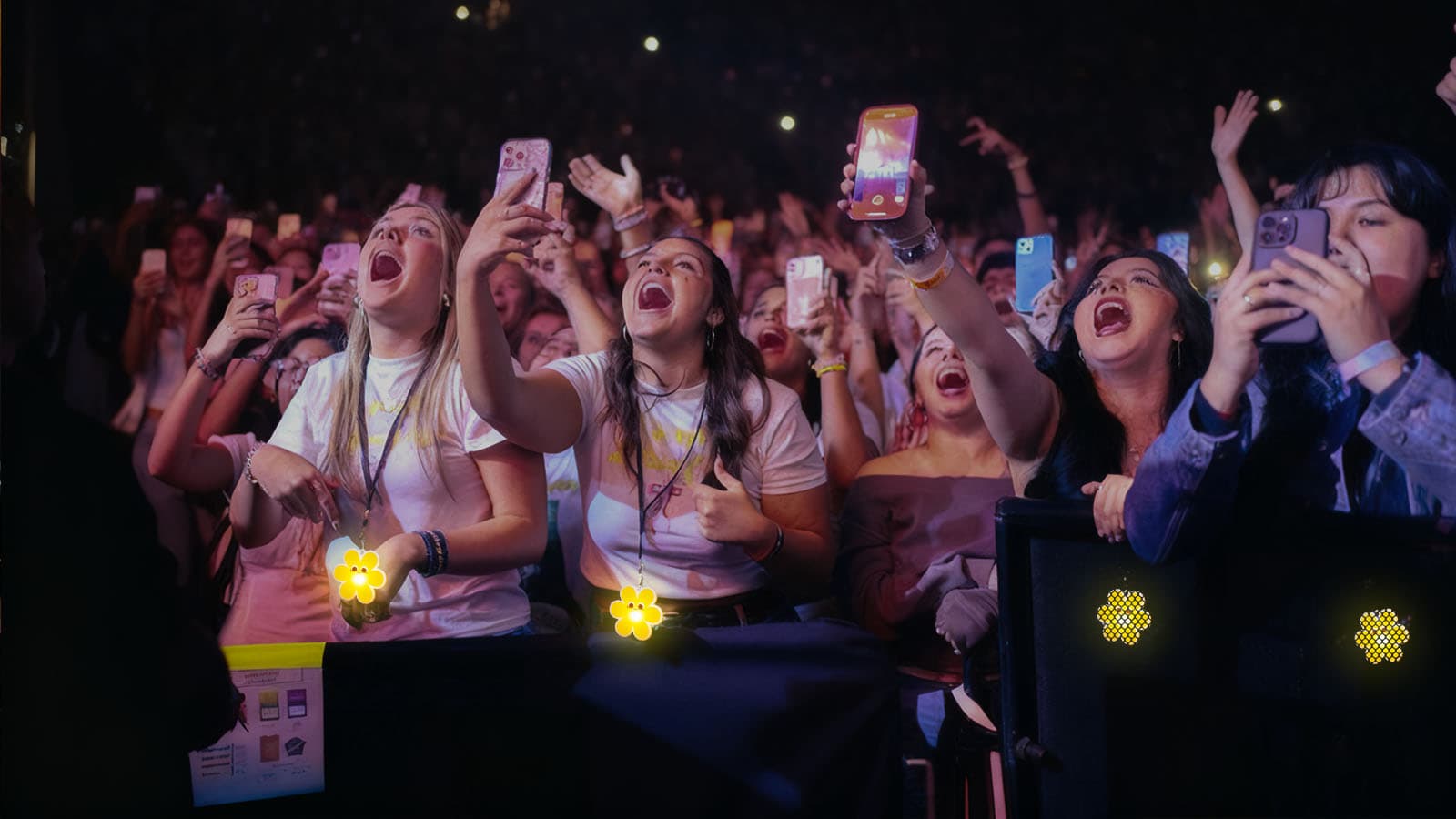
Intense burst. Concert drops, EDM stages, maximum-attention moments.
Gradual color transitions through 7 RGB colors. Refined ambiance.
Custom patterns are available via firmware programming — any frequency between 0.5 Hz and 20 Hz, with custom color sequences and brightness ramps, loaded during production.
Visibility depends on the model's LED count and the ambient light level. The flashing motion itself multiplies visibility: the human eye reacts to changes in light far more strongly than to constant light, which is why a flashing signal is recognized at longer distances than a steady one of the same brightness.
In daylight or brightly lit venues, the flashing effect is strongest at close range (up to 5-10 m). For outdoor daytime use, fast flash (3 Hz) and the higher-LED models (GFH-001, GFH-003) give the best visibility.
Four control methods, each serving a different need. All models include the built-in push button; the other three use transmitters purchased once and reusable across events.
Nearly every layer of the LED flashing lanyard is customizable — the visible branding, the light behavior, and the packaging:
Custom firmware (patterns, frequencies, brand color palettes) requires a minimum order of 200 units. Packaging and print customization start from the standard 200-unit MOQ.
Three application clusters account for most orders — each using the flashing function differently.
Strobe and fast flash for crowd energy. DMX sync turns the audience into part of the light show.
Fast flash identifies security, medical, and production staff instantly in crowds and low light.
Sponsor colors programmed into the LED palette turn the crowd into a walking brand display.
Four steps, one factory, one DDP price:
If you already know your flash requirement, this table shortens the decision to one line:
All five models share the same 4 built-in flash patterns, 7 RGB colors, and push-button control. The differences are brightness, light placement, material, and control upgrade options.
Tell us your quantity, model, flash pattern preference, and design requirements. We respond within 24 hours with a detailed quotation.
Fill in your details below and our sales team will get back to you.